EJ Meets: Inès Gradot
For issue 78, EJ’s Ruby Smallman sits down with Inès Gradot, a French artists, based in Glasgow, to explore the inspiration behind her art and risograph work.
Words by Ruby Smallman
In the bustling creative landscape of Glasgow, artist Inès Gradot wields a quiet yet powerful tool – observation. A multidisciplinary illustrator, graphic designer and master Risograph technician, Gradot uses drawing as a form of documentation, transforming the fleeting moments of her environment into resonant, experimental artwork. Her practice is a captivating alchemy of analogue and digital, where the tactile texture of Riso printing meets the immediacy of digital illustration.
How did you first come across risograph printing, and what initially drew you to the process?
I actually stumbled upon risoprinting by chance. I had printed a few posters back in art school, but it wasn’t a big obsession at first. The real spark came with our co-founded risoprinting collective, Riso sur Mer. Through our collaborative projects, I was able to play around with the technique. Since I wasn’t very experienced, I just tried different mediums to see what would happen once printed. That phase of experimentation is such a joy, discovering how things translate (or don’t!) through the machine. That’s really the magic of riso!
What have been the most rewarding aspects of working with risograph, so far? And what has been the most challenging?
The best part is definitely the element of surprise. Even when a print doesn’t turn out as expected, there’s always something beautiful in the result; a colour blend, a small misalignment, or a happy accident. It’s a constant dialogue with the machine, and I love that it never behaves the same way.
The biggest challenge is probably the jump from screen to print. What looks ‘perfect’ on the computer often comes out quite differently once it’s printed. The way colours overlap, the print settings, the choice of paper, they always add unexpected elements to the printed outcome.
In a world where much of art and design has gone digital, what do you feel risograph printing brings that other methods can’t?
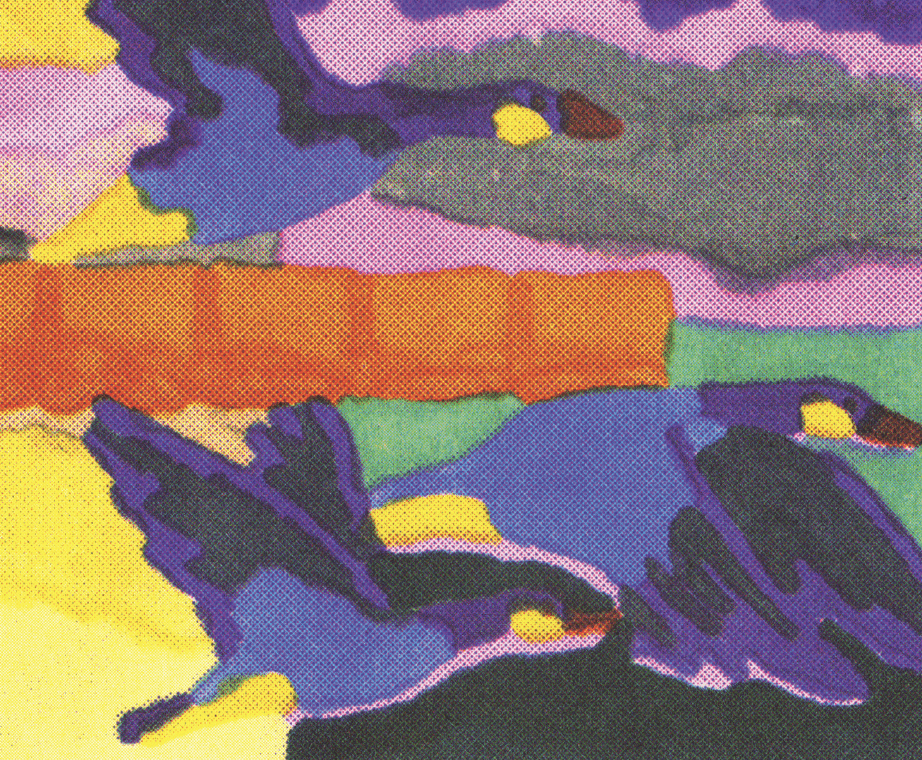
What I love most about riso is that it sits perfectly between the digital and handmade worlds. I usually start with hand-drawn work, prepare my files on the computer and end up with a printed object that feels tangible and alive. The slight variations in layering, the grain of the paper, the misregistration, they all give each copy its own personality.
There’s something very grounding about that in a time when everything else feels infinitely replicable. It creates a kind of full circle: the drawing and the print share similarities, but each remains unique, with its own quirks and charms.
What’s your opinion on AI in the design world?
Honestly, I’m pretty out of the loop when it comes to AI. I’ve always preferred working by hand and using the computer as little as possible, so I see AI as just another tool designers can use if they find it helpful. Personally, I think people will always be drawn to tangible, handmade things. The process of making is one of the most exciting parts, and I’d rather let AI handle the boring stuff than take over the creative part for me!
I’m sure there are interesting aspects to explore, but I’m cautious about how much energy and natural resources these technologies consume. So for now, I’m staying a bit apart from it. There’s still something about leaving a physical trace that feels far more meaningful and alive to me.
What’s the most exciting project/piece you have worked on?
About a year ago, I got the chance to design a series of Hermès window displays for their U.S. stores, which was honestly a dream project. It felt surreal to see my small drawings turn into large, soft, sculptural installations. My work usually lives in two dimensions, so seeing it expand into physical space and become something people could actually walk past and experience was incredible. It gave me an appetite to explore more crossovers between illustration, design, and sculpture.
How do you see your practice developing in the next few years?
As mentioned, I’d love to keep expanding my work through installations and space and see how these drawings could take on new forms when their scale or material changes, whether that’s a theatre set, a piece of furniture, or an exhibition. I’ve also always been curious about animation, though I haven’t really had the chance to dive into it properly yet. It sounds like a fun new challenge, and a medium that would offer so many possibilities to explore movement and rhythm outside of the still page.