

A Cut Above: Three Tailoring Houses Breathing New Life Into British Bespoke
Matthew Gonzalez talks us through an exciting new wave of bespoke tailors
Words by Matthew Gonzalez
There’s something intrinsically special about small independent shops and artisanal craftspeople. Knowing that someone is passionate enough to go out on their own to create a product that they have a particular love for is itself appealing. While most of us have relied on larger chains and conglomerates to get through the pandemic, it’s the independent shops that need more support than ever to keep their doors open.
I have never been more aware of this until now, having recently left my cutting position on Savile Row in order to start up a tailoring house under my own name, Matthew Gonzalez. Over the past few months, while I was planning my business, I got to catch up with two other independent tailors who are also making their mark on the bespoke scene. We discussed the challenges and opportunities that lay ahead and why three new tailors with drastically different house styles are exactly what the industry needs right now to stay alive.
Photography by Faye Fearon
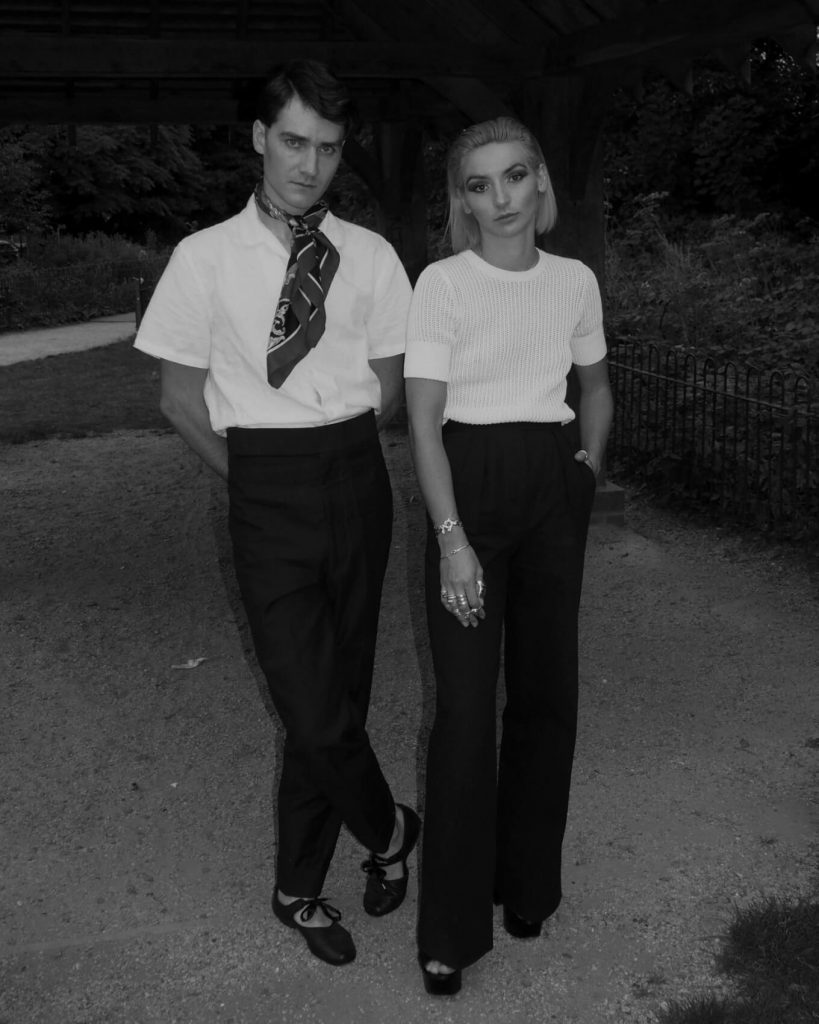
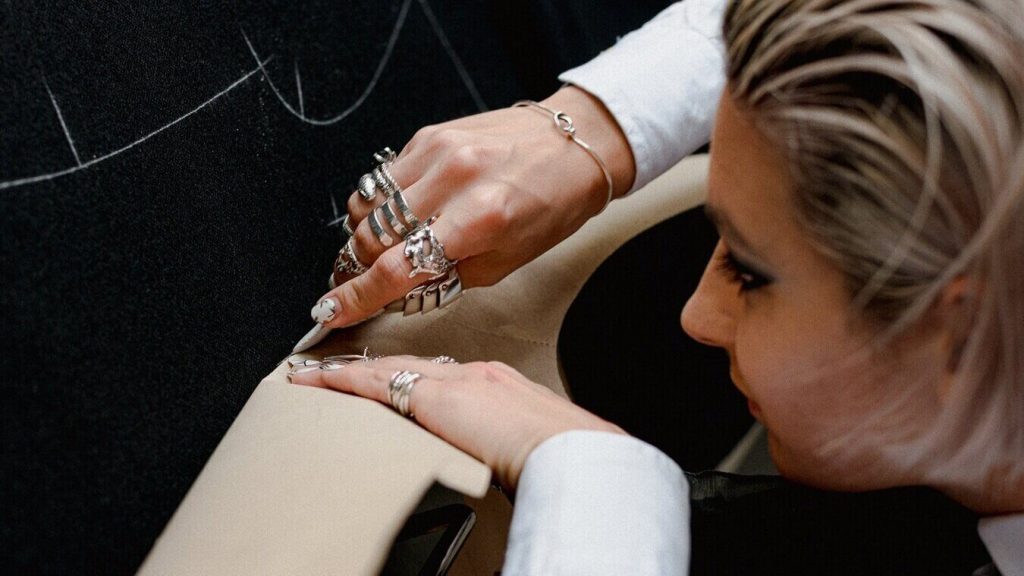
The ultimate question for everyone in the tailoring trade at the moment is this: how do you sell suits in the era of lockdowns, working from home, and casual Zoom meetings? When I spoke to Kimberley Lawton and Joshua Dobrik of Dobrik & Lawton they told me that they were trying to capture a completely different side of the bespoke market. ‘We want to blur the barriers of formality and offer clothing that is more accessible to people with all kinds of style interests,’ Dobrik says to me. When you scroll through their account on Instagram, you’ll understand exactly what he means. While they have plenty of pictures of traditional tailoring, their feed is also full of tailored boiler suits, ornately-paneled casual jackets, and even a fluorescent, sci-fi-esque, breastplate that they created for Brian May’s 2019 USA tour.
Photography by Alex Natt
Their clothing seemingly creates a house narrative that blends the traditional, tailored structure of a suit with the ostentation of contemporary human tastes. It’s a style that is appealing to both the consumer and artisan within me. ‘We wanted our clothing to stand out against the sea of blues and greys you normally see in tailoring,’ Lawton explains to me. As an observer of fashion, I’m impressed with how D&L created a remarkably timeless aesthetic by reinterpreting elements of roaring ’20s decadence, mid-century minimalism, and 21st-century self-expression.
As a tailor, I can see that everything they make is still of the highest possible quality. Josh and Kimberley both exhibit who they are within their designs. The tailoring is a step beyond what you would normally find coming out of Savile Row and as a result breathes new life into a trade that has been badly impacted by the pandemic. When I asked Lawton about the process, she told me that a D&L commission normally takes 12 weeks to complete and starts at £4950.
Photography by Alex Natt
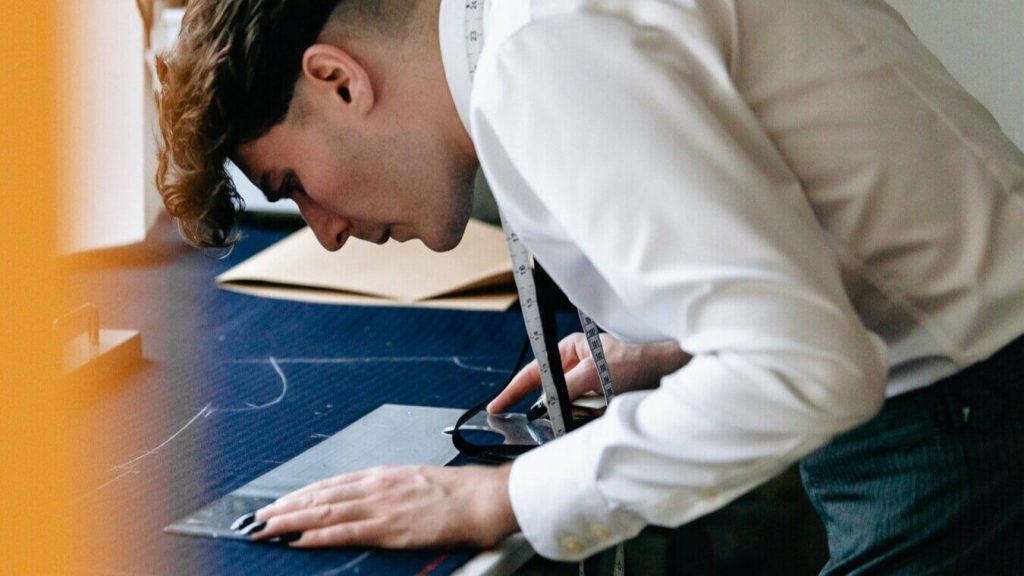
When I posed the same question to Reza Haraji, founder of AKEILĀ he was reluctant to make any concrete predictions about the future, but acknowledged that tailors will inherit a post-pandemic ‘casualisation of clothing’ due to remote working. If you were to listen to Reza talk about tailoring, you would instantly recognise that you were speaking with a true artisan. His work elevates and refines the meaning of bespoke. While his company IG page is still in its early days, scrolling through Reza’s personal account reveals a true ode to tradition, creativity, and architectural-like structure in the form of clothing.
His focus, as evidenced in his posts, is on the ‘radical attention to process, experience, and details.’ As we discussed his philosophy of tailoring, he told me that ‘mastery of something is one of the most important journeys and achievements in life.’ By that he not only means mastering the technical ability to make a suit but also how to solve problems and exhibit leadership at every level of the process and within his organisation.

When I asked about his house cut he said that he preferred to approach things through a ‘house process’ that focuses on extreme attention to detail and allowing the client’s own personality to be the driving force behind each order. That said, structure seems to underlay the foundation of Reza’s style. He seems to create suits from the perspective of both a tailor and a structural engineer. He can easily be called a structuralist when it comes to clothing. If a skyscraper is an architect’s monument to a city then his suits are a monument to the human form. As we discussed his process, Reza was very matter-of-fact about how he is probably one of the most expensive tailors in the trade and, for the time being, his price is currently available upon consultation. As for the turnaround time? ‘As long as is necessary.’
What is particularly interesting about Reza’s philosophy of tailoring is that he has been very forthcoming with his own knowledge and experience. In the autumn of 2020, he began posting videos on YouTube on how an actual bespoke tailor makes a jacket. As of the end of March this year he is on part 35 of an unknown number of remaining videos which meticulously go step by step through the entire process. As we talked Reza spoke about how he feels the trade needs as many great tailoring shops as possible. Not to necessarily compete for the same clients but to keep everyone at the top of their own game, a position with which I could not agree more.
Admittedly, it is difficult to write about myself. Clearly, I am not unbiased in the matter, however, just like Joshua, Kimberley, and Reza, I too had to consider how bespoke tailoring would fit within the future of menswear. As I was setting up on my own business, I recognised that it was time for tailors to start thinking beyond the classic bespoke two-piece. We need to dress men for their entire lives, regardless of whether or not that includes wearing a suit.
This new perspective actually came quite naturally to me. Growing up in Long Beach California, a largely laid-back coastal community within Los Angeles County, I felt completely at home in casual wear. I loved the rugged utility of the 1950s-style American workwear that the rockabillies in LA would dress themselves in. That clothing instantly conjures up imagery of the understated coolness of James Dean in Rebel Without a Cause. It’s clothing that’s built for utility and comfort and it’s made to last. It was a world away from the high-end and sometimes rigid style of British bespoke tailoring, with its sharp waistlines of structured shoulders that I found myself in when I moved to London in 2007.
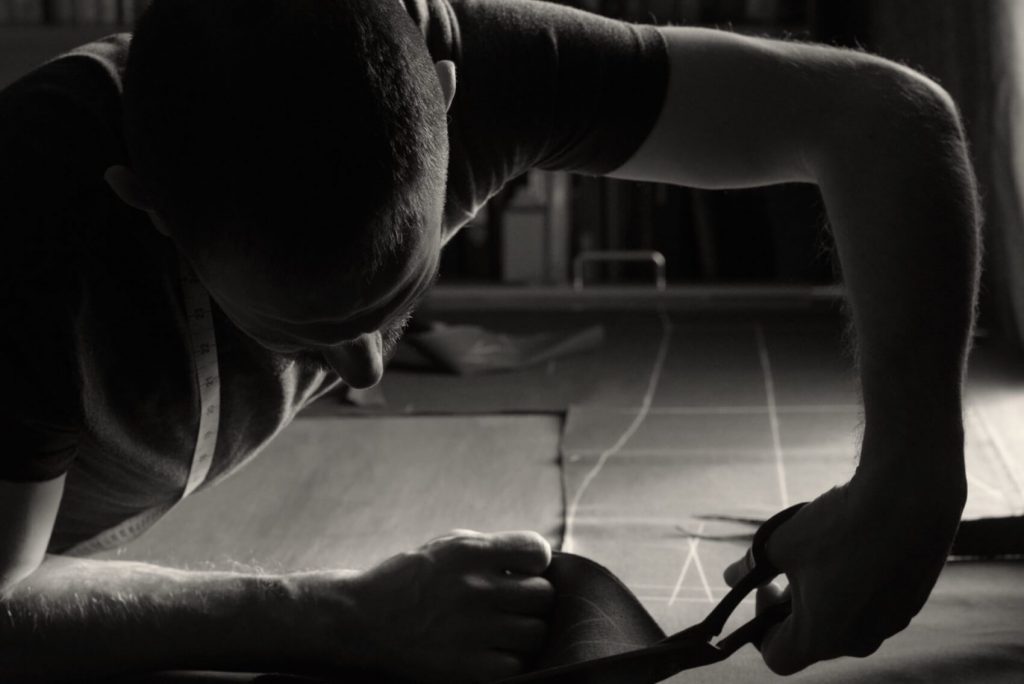
When I talk to clients and friends about my style, I tell them it’s a blend of mid-century American Design with contemporary British silhouettes. In that way, it represents my story, how I dress, and most importantly it isn’t restricted by some traditional notion of what tailoring must be. My aim is to keep the design as minimalist as possible and allow the rich textures and colours of the woolens, brushed cottons, and plain tweeds that I like to work with to complement the cut of the suit.
That said, no detail is left unconsidered: the cloth; the canvas; the thread; the buttons are all painstakingly sourced. The tailors I work with to make everything are without a doubt some of the best in the world. Every new client has a fitting in a mock-up fabric, called a toile, just to ensure their pattern is perfect before I even consider cutting their selected fabric. All of this energy goes into every garment because anything less than perfection would be a disservice to anyone paying me to make a garment for them.
Taking the next step beyond bespoke tailoring I also offer a service that is unlike any other called Bespoke Ready to Wear. Initially, there are three house styles: a mid-century mechanic’s jacket; a classic chore jacket; and the British field jacket. Clients select from a curated range of cloth that will best suit the style of each then choose from a series of design details. From there, measures are taken and a bespoke pattern is cut by hand and a bespoke fitting is made up. After the first fitting, the ready-to-wear aspect comes into play and the jacket is machine-finished as opposed to hand-finished like a classic bespoke suit – meaning that it is more affordable while still being made to last.
These two services, bespoke and bespoke ready to wear, are designed to be timeless pieces in any man’s wardrobe. Bespoke suiting starts at £4000 while bespoke ready to wear starts at £1500. Both take anywhere from 12 to 14 weeks to complete.
One of the most interesting aspects of the new wave of bespoke tailoring houses is the diversity of style. While each Savile Row firm will have their own house cut most (not all, but the vast majority) work within the same parameters of a traditional suit. That is just not true for the new generation of tailoring houses. The same idea is true about the quality of suits in general. Most heritage houses have a name and history that is, in part, what makes them alluring. The bar was set in Savile Row over a century and a half ago. The new generation of tailoring houses doesn’t have the history to draw in new clients. Instead, we must create garments that speak for themselves. In that respect, there is a lot of value in supporting new independent tailoring houses, because if we don’t deliver, we don’t exist.
Learn more about Matthew’s bespoke and bespoke Ready-to-wear options here.


